
Did your retail prices move with your last supplier increase?
Your suppliers raised their prices this year, probably two or three times. The question is whether your pricebook followed.
For most shops the honest answer is no, or not all the way, and the difference between the cost you pay now and the price your book still charges is margin you are giving away on every job, without deciding to.
How the gap opens
It is not dramatic, which is why it works. A supplier sends a routine cost update in the spring, another in the summer, another in the fall. Each one is a few percent on a list of parts. None of them feels like an event. To see what a supplier increase changed in your book, drop your export and the new price list into the cost updater.
But your pricebook only changes when someone changes it, and between go-live and now, usually nobody did. So the cost line steps up three times and the price line sits flat, and the gap between them is the margin you used to make and now do not.
The cruel part is that the higher-volume the item, the more it costs you, because you sell it more often. The parts a tech touches dozens of times a week are exactly the ones where a frozen price quietly drains the most. It is the same mechanism behind the zero-markup SKUs hiding in your book: cost moved, price did not, and the markup got eaten from underneath.
The same gap inside one week: quote Monday, install Friday
The gap does not only open across a year. It opens inside jobs you already won. You quote a system on Monday. Your supplier raises the condenser price on Wednesday. You install on Friday and invoice Monday’s price. You just ate the increase, and across 200 installs a year, the “where did our margin go?” question answers itself.
The cause is the same: a markup baked in as a fixed dollar number. The moment material cost moves, that number is wrong, and nobody notices until the month closes light. A book built right ties each install to labor hours and a live material cost, so when the condenser goes up 8% on Wednesday, Friday’s price already reflects it.
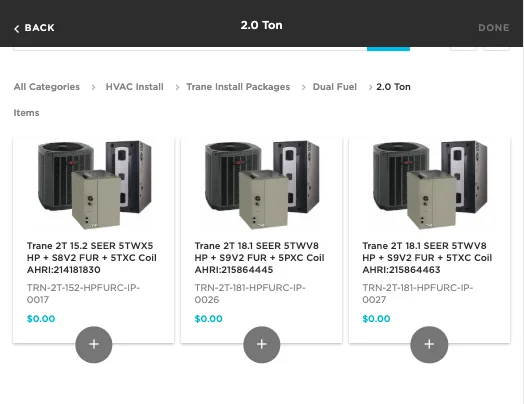 Install packages built so pricing is structured and consistent, not retyped in a driveway.
Why a flat percentage isn’t the fix
When shops finally notice, the instinct is to add a blanket percentage across the book. Do not. A flat bump prices some items too high and still leaves others below cost, because the increases were never uniform and your markups were never uniform either.
The right move is to re-cost from the actual updated supplier numbers and recalculate each price from your target markup or your loaded labor rate. If your supplier is connected to ServiceTitan, here is what a supplier integration does and does not update.
That is what keeps the book defensible instead of just higher.
The structural fix: stop updating prices by hand
The reason books fall behind is that updating them is manual, and manual things slip. The structural fix is dynamic pricing: when prices are driven by cost and a markup rule, you update the costs and the prices move on their own. That is the entire argument for turning it on, covered in the ServiceTitan dynamic pricing guide. To get the value for every field of a dynamic pricing rule, use the free ServiceTitan dynamic pricing calculator.
It does not work without a correct loaded labor rate underneath it. But once it is set, a supplier increase becomes a cost update instead of a project.
This is also why a pricebook is maintenance, not a one-time setup. Even with dynamic pricing, someone has to load the new costs each quarter. The difference is whether that takes an afternoon or a week.
Check yours this week
You do not have to guess whether your book kept up. The free Pricebook Health Audit reads your export and shows you the items selling below today’s cost and the markups that have drifted since go-live. If the gap is wide, or if you want the book rebuilt on a loaded labor rate with dynamic pricing so it follows costs automatically, that is the work we do.
If your supplier connects to ServiceTitan, here is how supplier integrations work, including why a synced cost does not move your price on its own.
Common questions
Why does my margin drop between the quote and the install?
Because the price was frozen when you quoted it. If the supplier raises the condenser between Monday's quote and Friday's install, a fixed-dollar markup charges Monday's price on Friday's cost and you eat the difference. Tie each install to labor hours and a live material cost, so the price recalculates when the inputs change.
How do I update my ServiceTitan pricebook after a supplier price increase?
Pull the updated cost list from your supplier, match it to the items in your pricebook, and recalculate each selling price from your target markup or loaded labor rate, not by adding a flat percentage. With dynamic pricing configured, updating the costs updates the prices automatically. Without it, you update the prices by hand, which is why most books fall behind.
How often do HVAC suppliers raise prices?
Commonly two or three times a year, and more in volatile years. Each increase that your pricebook doesn't follow widens the gap between your cost and your price, quietly cutting your margin on every affected item until you re-cost the book.