
Good, better, best: each tier should answer a different question
Most good/better/best proposals don’t work, and the reason is simple: the three options are the same system at three prices. The homeowner looks at them, sees “cheap, medium, expensive,” and picks cheap. If your tiers only differ by a number, you’ve built a discount menu, not a sales tool.
The fix is to make each tier answer a different question the homeowner is already asking in their head.
The mistake almost everyone makes
The common build is one system, then “better” and “best” versions that cost more for upgrades the customer doesn’t understand. “Premium.” “Plus.” Vague words, bigger number. The homeowner has no way to judge what the extra money buys, so they default to the cheapest thing that solves the problem. You trained them to.
Build each tier around a question
- Good answers “Will this fix my problem and meet code?”: a solid, reliable system with a real warranty. No apologies; it’s a genuinely good option.
- Better answers “What’s it like to actually live with?”: higher efficiency, quieter operation, better comfort, a longer warranty. This is the comfort-and-bills tier.
- Best answers “What if I want the best for the long haul?”: top efficiency, smart controls, whole-home integration, the longest coverage.
Now the homeowner isn’t comparing three prices. They’re choosing how far up their own priorities they want to go. The tier that sells isn’t the cheapest. It’s the one they understand.
This isn’t theory. On real plumbing books we’ve measured, when the customer takes a middle tier they actually understand instead of the only option, the ticket routinely jumps on the order of 50%. Same trucks, same techs, same leads (the five signs post has the rest of those numbers).
On bigger HVAC installs we add a fourth tier, a premium-plus option for the long-haul buyer, but the rule doesn’t change: if a tier doesn’t answer its own question, it’s just a bigger number.
A ladder can also break in the other direction: in one real book the third option was worse than the second, because best had dropped to a lower efficiency unit, and it shipped for months.
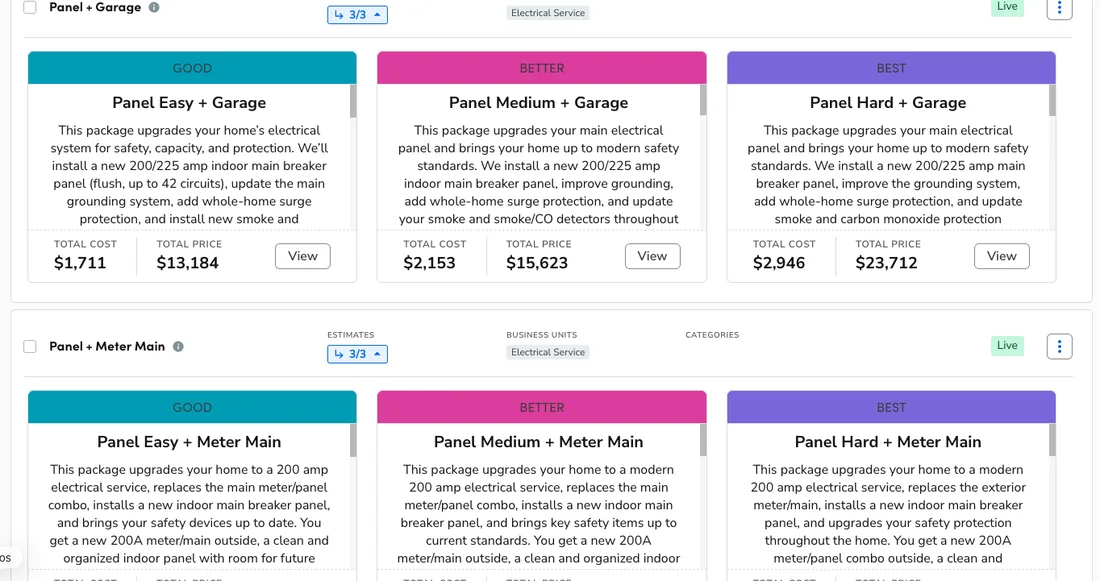 Good, better, best built as three real answers, here on an electrical panel upgrade, not one system at three prices.
Why this has to live in the pricebook
You can’t expect a tech to construct this on a tailgate (that’s the 45-minute driveway problem). The three questions, the right equipment for each, and the language that explains them get built once, in the office, and dropped into The Present-Don’t-Configure Method™ as ready-to-present options. Then every tech presents the same strong three choices, in every home.
Build the tiers to answer questions, not to climb a price ladder, and your better and best options start carrying their weight. If yours are just three prices today, that’s exactly what a pricebook build fixes.