
Flat rate pricing examples, worked out job by job

Flat rate pricing means the customer gets one price for the job before any work starts. Every example on this page is built the same way: your hourly rate x the hours the job takes, plus the material cost with your markup, rounded up, never below your minimum. Below, that formula is worked out on 20 real HVAC, plumbing, electrical and handyman jobs, with the math shown each time and screenshots from the actual price files.
One honest note before the numbers. The hours and parts costs here are examples written to show the math. They are not a survey of what shops in your area charge. Your own hours and your own supplier costs go in their place. The math does not change.
The formula, in four steps
- Rate x hours. Use your loaded labor rate: what a billed hour really costs you, plus your profit. Not the wage. If you are not sure what that number is, the loaded labor rate calculator works it out in a few minutes.
- Plus materials, with your markup. What the parts cost you, times 1 plus your markup. At 30% markup, $100 of parts becomes $130.
- Round up to a clean number, $5 or $10. Always up.
- Never below your minimum. A 20-minute job still costs you the drive, the setup and the invoice.
That is the whole method. Everything else on this page is choosing honest hours and real parts costs.
Try the formula on your own job
Type your own numbers. It starts on the capacitor above: $150 an hour, 0.75 hours, $25 of parts, 30% markup.
Flat rate price $145
$150/hr x 0.75 hr = $112.50, + materials $32.50 = $145.00, rounded up to $145.
One job at a time works at the desk. In the driveway, every tech needs every job on one sheet: the Flat Rate Pricing Calculator price card, $179, 15 minutes to 40 hours at your own crew and markup.
The same job, billed hourly and flat rate
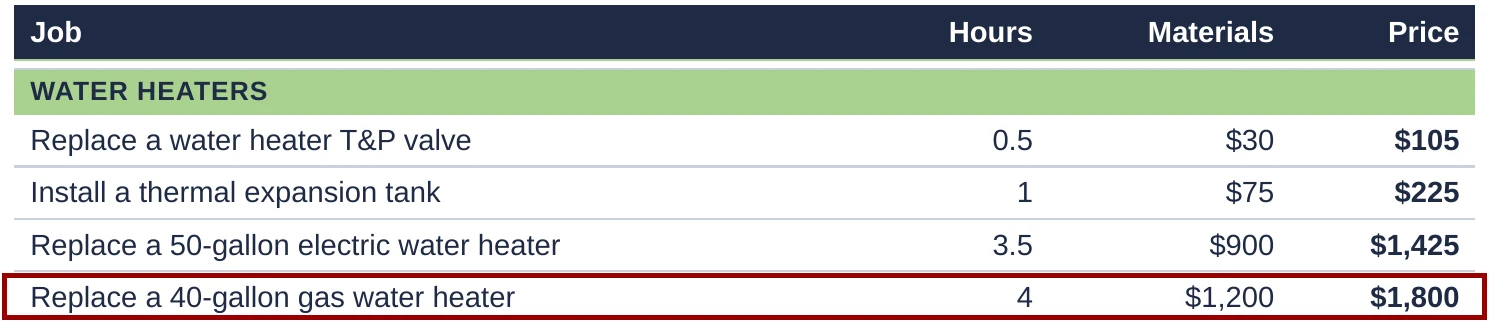
Here is why shops switch. Take one job from our free plumbing price list: replacing a 40-gallon gas water heater. One plumber at $150 an hour, $1,200 of materials at cost, 4 hours on a normal day.
Now bill the same job by the hour, on three different days.
Look at what hourly does. On the slow day, the customer pays $225 more for the same water heater. Maybe a fitting fought back, maybe the old tank would not drain. Not the customer’s fault, but the customer’s bill. On the fast day, your best plumber earns the shop $150 less than an average one. Hourly punishes the customer for bad luck and punishes you for good work.
Flat rate takes the normal day, prices it once, and quotes $1,800 every time. The customer says yes to a number. The plumber who finishes early is not losing you money. That is the trade: the shop carries the risk of a slow day, so the hours behind the price have to be honest.
HVAC flat rate pricing examples
Priced at $150 an hour, 30% markup on parts, rounded up to $5.
| Job | Hours | Parts | The math | Price |
|---|---|---|---|---|
| Replace a run capacitor | 0.75 | $25 | $112.50 + $32.50 | $145 |
| Replace a condenser contactor | 1 | $35 | $150 + $45.50 | $200 |
| Clear a clogged condensate drain line | 1 | $10 | $150 + $13 | $165 |
| Replace a condenser fan motor | 1.5 | $180 | $225 + $234 | $460 |
| Replace a PSC blower motor | 2 | $220 | $300 + $286 | $590 |
Look at the drain line and the fan motor. The drain line is almost all labor, so it prices close to one billed hour. The fan motor is about half labor and half parts, so the markup does more of the work. Same formula, very different shape. That is why one hourly rate can never stand in for a price book: the parts change the answer.
Plumbing flat rate pricing examples
From the free plumbing price list: one plumber at $150 an hour, materials at cost, rounded up to $5.
| Job | Hours | Materials | The math | Price |
|---|---|---|---|---|
| Replace a toilet fill valve | 0.5 | $20 | $75 + $20 | $95 |
| Replace a kitchen faucet | 1 | $150 | $150 + $150 | $300 |
| Install a thermal expansion tank | 1 | $75 | $150 + $75 | $225 |
| Install a pressure reducing valve | 2 | $200 | $300 + $200 | $500 |
| Replace a 40-gallon gas water heater | 4 | $1,200 | $600 + $1,200 | $1,800 |
This list puts materials at cost, so the shop earns only on labor. Some plumbers choose that on big-ticket parts like water heaters. Put a 20% markup on the water heater’s $1,200 and the price becomes $2,040: $600 + $1,440. Notice the expansion tank has its own line and its own price. Hold on to that. It comes back later.
Electrical flat rate pricing examples
These are read straight off the Flat Rate Pricing Calculator price card: one electrician at $300 an hour, 0% markup, rounded up to $5. A price card is a grid. Hours run across the top, material cost runs down the side, and the price sits where they meet.
| Job | Hours | Materials | Read on the card | Price |
|---|---|---|---|---|
| Replace a light fixture (customer’s fixture) | 1 | $30 | 1 hr column, $30 row | $330 |
| Add an outdoor GFCI outlet | 1.5 | $45 | 1.5 hr column, $50 row | $500 |
| Install a whole-home surge protector | 1.5 | $200 | 1.5 hr column, $200 row | $650 |
| Run a new 20-amp circuit to the garage | 4.3 | $160 | 4.5 hr column, $200 row | $1,550 |
The last job shows how a card works. The job takes 4.3 hours, so you read the 4.5 column. The parts cost $160, so you read the $200 row. Where they meet: $1,550.
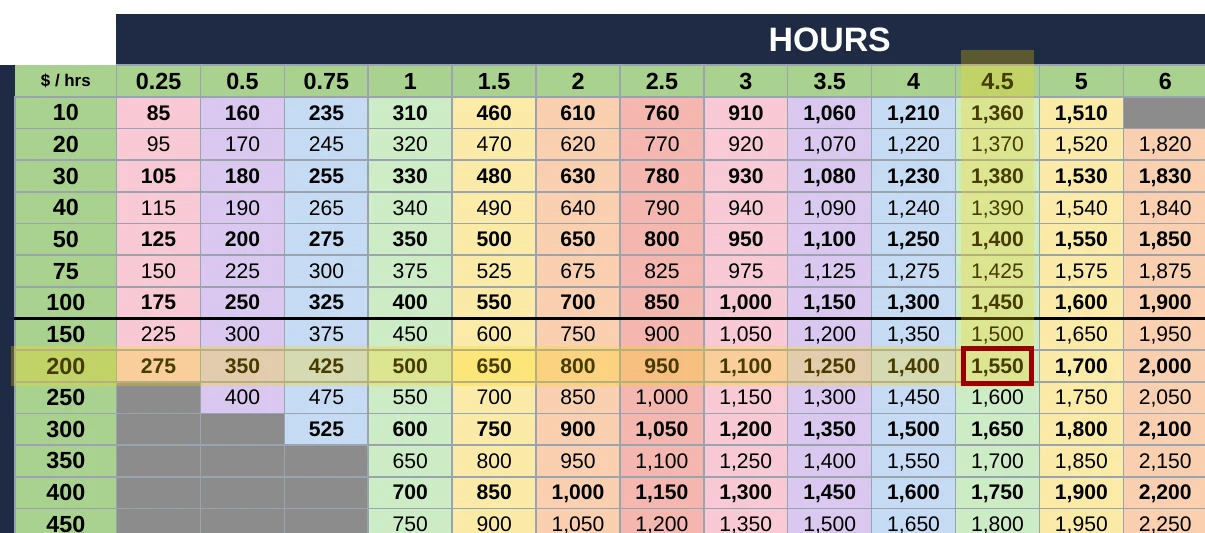
Worked out exactly, the formula gives 4.3 x $300 + $160 = $1,450. The card gives $1,550. The card always reads up, never down, so a job is never priced short. That $100 is the cushion for the job that runs a little long. You can see the other three jobs on the same grid: 1 hour and $30 is $330, 1.5 hours and $50 is $500, 1.5 hours and $200 is $650.
Handyman flat rate pricing examples
A handyman sample: $95 an hour, 30% markup, a $150 minimum, rounded up to $5.
| Job | Hours | Materials | The math | Price |
|---|---|---|---|---|
| Patch a medium drywall hole | 2.5 | $25 | $237.50 + $32.50 | $270 |
| Replace baseboard, one room | 3.5 | $95 | $332.50 + $123.50 = $456 | $460 |
| Paint one room, walls, two coats | 5.5 | $95 | $522.50 + $123.50 = $646 | $650 |
| Replace a door knob | 0.5 | $28 | $47.50 + $36.40 = $83.90 | $150 (minimum) |
Two things to see here. The baseboard and the paint job both round up, $456 to $460 and $646 to $650. And the door knob is the minimum at work. The math says $84, but a visit costs more than that to run, so it goes out at $150. A service call fee does the same job as a minimum. Our Handyman Flat Rate Price Book charges a $75 service call fee once per visit instead: the door knob is $85, so a visit for it is $75 + $85 = $160. If you want to start smaller, the free handyman price list has 30 jobs as a PDF and an Excel file.
Two people, one job: price the crew
Some jobs need two people. Flat rate handles that by pricing the crew, not the person. This is the most common mistake in homemade price lists.
The job is moving a water heater to a new closet: 6 hours and $430 of materials, read on the $450 row of the card. With one lead at $300 an hour and a helper at $225, the crew costs $525 an hour. 6 x $525 + $450 = $3,600.
Price it at one person’s rate and it comes out at $2,250. The shop sends two people and gets paid for one. That is $1,350 of labor gone, on a single job.
Good, Better, Best works the same way
Options do not change the formula. Each option is its own flat rate price, with its own hours and its own parts. Here is mounting a TV, from the handyman book:
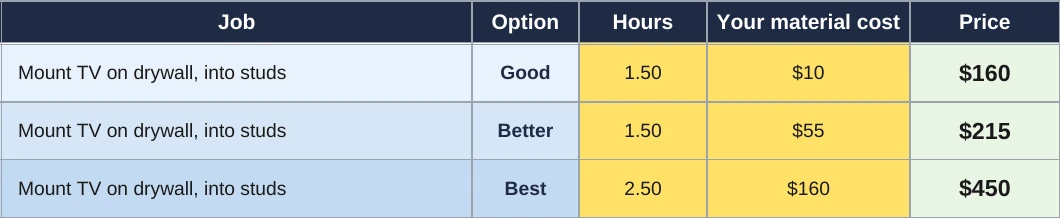
- Good, $160, the customer’s mount: 1.5 x $95 = $142.50, plus $10 x 1.3 = $13. $155.50, rounded up to $160.
- Better, $215, we supply a tilting mount: 1.5 x $95 = $142.50, plus $55 x 1.3 = $71.50. $214, rounded up to $215.
- Best, $450, full-motion mount and in-wall power kit: 2.5 x $95 = $237.50, plus $160 x 1.3 = $208. $445.50, rounded up to $450.
The customer chooses between three results, each with a known price. Nobody argues about the hours, because nobody sees them. They see what each option gets them.
What I learned the hard way: price what goes on the truck
I ran a plumbing company for 12 years. One of my most expensive lessons had nothing to do with the hourly rate.
On water heater installs, my techs were adding a drip pan, a ball valve, an expansion tank, extra pipe and fittings, and disconnect wiring. Real parts and real labor. And they were not charging for any of it. They assumed it all came with the install, because nothing in the book told them otherwise. The work was good. The tickets were short.
I caught it reviewing jobs. It was not a tech problem. It was a book problem. So I rebuilt the book as building blocks: the main job, with each extra sitting right next to it as its own line with its own price. Drip pan. Expansion tank. Disconnect. The tech no longer had to remember what was extra. He could see it. The numbers got better right away, with the same techs on the same calls.
That is why the expansion tank has its own line on the plumbing list above. A flat rate price is only as good as what it covers. Write down what is included in every price, and give every extra its own line. (The longer version of this story is in what ServiceTitan is and where shops lose money.)
Flat rate examples outside the trades
The idea is older than any pricebook. Auto repair shops quote labor from a book of standard times per job. Lawyers quote a flat fee for a simple will. A phone plan is one price a month, no matter how many calls you make. In every case the seller carries the time risk, and the buyer gets a number to say yes to. The trades version just has more moving parts: hours, parts, markup, crew and a minimum.
Five ways flat rate prices go wrong
- Wage instead of loaded rate. Price at what you pay the tech, and the truck, the insurance and the office ride for free. They are not free.
- Best-day hours. If the job takes 1 hour on a good day and 1.5 on a normal one, price 1.5. The water heater above shows what a slow day costs.
- No minimum. Small jobs priced by the formula alone lose money on the drive. See the door knob.
- One person’s rate on a two-person job. See the $1,350 above.
- Extras not on their own line. See my water heaters. If it is not written down, it gets given away.
Where to start
- Work out your real hourly number with the free loaded labor rate calculator.
- Price one job right now with the free flat rate pricing calculator, or print the free flat rate pricing PDF.
- Start from a list for your trade: the free plumbing price list, or the free handyman price list and the full 177-job handyman price book. Electricians and plumbers: the Electrical Flat Rate Price Book and the Plumbing Flat Rate Price Book.
- When you want every job priced at once, at your own rate and crew, the Flat Rate Pricing Calculator puts them all on one card.
For the why behind all of it, read flat rate pricing for the trades.
Common questions
What is an example of flat rate pricing?
Replacing a run capacitor on an AC unit. The tech quotes one price before starting, $145, instead of billing time and parts. Behind it: 0.75 hours at $150 an hour is $112.50, plus $25 of parts with a 30% markup is $32.50. That is $145. The customer pays $145 whether the swap takes 30 minutes or 50.
How do you calculate a flat rate price?
Your hourly rate times the hours the job takes, plus the material cost with your markup, rounded up to a clean number, and never below your minimum charge. Use your loaded labor rate, the real cost of a billed hour, as the rate, not the wage you pay.
What are HVAC flat rate pricing examples?
At $150 an hour and 30% markup on parts: a run capacitor (0.75 hours, $25 of parts) is $145, a condenser contactor (1 hour, $35) is $200, clearing a condensate drain (1 hour, $10) is $165, a condenser fan motor (1.5 hours, $180) is $460 and a PSC blower motor (2 hours, $220) is $590.
Is flat rate pricing more expensive than hourly for the customer?
Not on an average job. A 40-gallon gas water heater at $150 an hour and $1,200 of parts is $1,800 flat. Billed hourly, the same job is $1,650 on a fast day, $1,800 on a normal day and $2,025 on a slow day. Flat rate gives the customer the normal-day price every time, agreed before the work starts.
What happens if the job takes longer than the flat rate?
The shop keeps the risk and the customer keeps the price. That is why the hours behind each price should be the time the job takes on a normal day, not the best day. When a job keeps running long, the hours in the book get changed.